
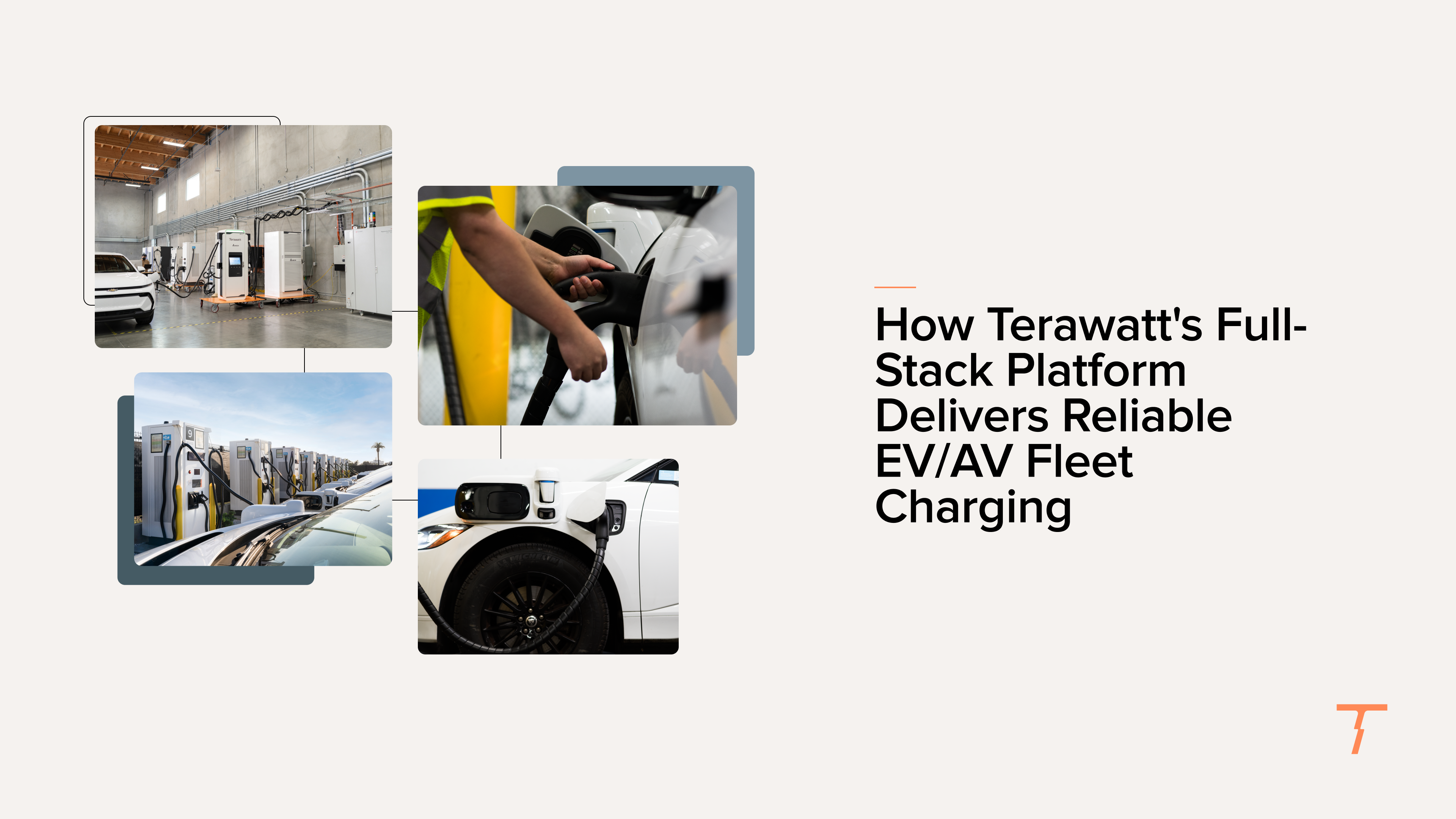
How Terawatt's Full-Stack Platform Delivers Reliable EV/AV Fleet Charging
EVs have been on American roads for almost 20 years, but transportation remains the single largest source of US emissions. The bottleneck to electrification is no longer the vehicle; it's the charging infrastructure that’s insufficient.
Terawatt exists to change that. Our mission is to electrify all miles for a safer, cleaner planet. We operate a network of sites across the country that deliver power and reliable operational support to electric fleets of all sizes, from autonomous vehicles to heavy-duty trucks. To do that, we’re building a full-stack infrastructure platform that enables the transition to electric mobility at scale.
Keep reading for a breakdown on how our technology impacts the customer experience today – and lays the foundation that will unlock a future of fleet-scale electrification.
How does Terawatt's technology platform work for fleets?
Commercial fleets have high reliability standards: logistics is an unforgiving business, and every mile and minute counts. In order to operate profitably, vehicles need to be able to get power on demand and on time, but most charging infrastructure today wasn’t designed or specified to meet commercial requirements.
Recognizing the challenge for large-scale fleet electrification, Terawatt has an integrated technology platform designed to remove friction at every touchpoint, from onboarding to charging to reporting. This allows us to bridge the shortcomings of the current charging options and deliver the level of service that fleets need in order to operate. Here’s how it works:
Choosing the right partners: The journey starts with site design and vendor selection. We choose the right level of electrical service and connection for our customers, and we carefully select site development and construction partners to ensure our sites can deliver what customers need now and in the future.
A key component of this is charger selection, which can be a months-long process. From data gathering to lab validation, we put chargers through intensive quality testing and evaluate how flexible vendors can be in reacting to and resolving issues quickly, as well meeting future needs. Through this testing, we often uncover problems are fixed before deployment to our charging facilities. All of this ensures that we deeply understand the performance and operations of chargers we deploy, giving customers one less thing to worry about.
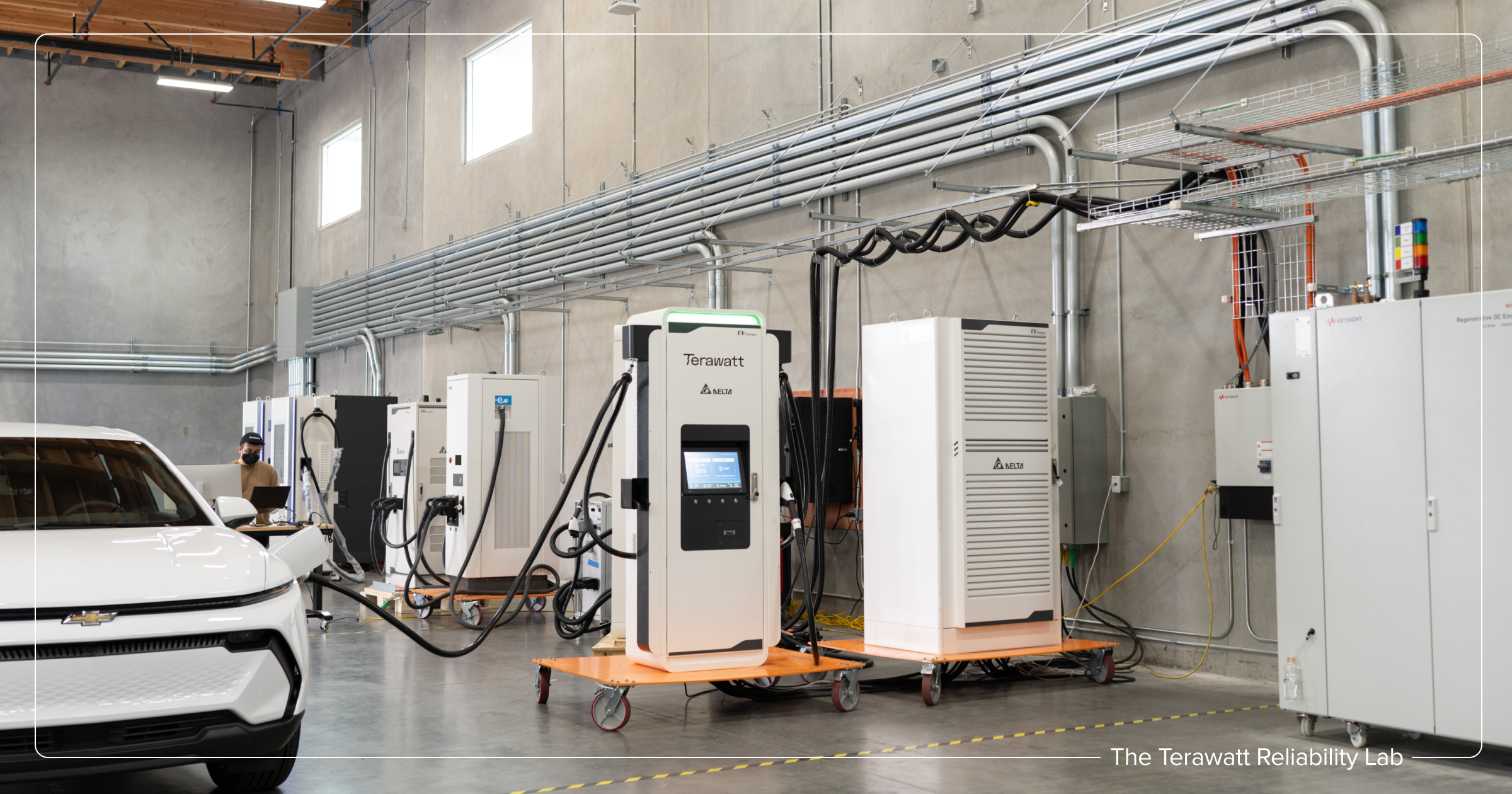
Before a vehicle ever plugs in: We perform a suite of interoperability tests in our Reliability lab, covering the specific combinations of vehicles, chargers, and software that each fleet will encounter at our sites. To ensure consistent reliable experiences, we repeat these tests periodically as vehicle software, vehicle platforms, and our own software feature set evolves. We evaluate new software releases on our chargers at our lab before any rollout to our sites, and provide our Operations team tools to address issues as they arise.
Planning the visit: Fleets need to know charger availability so they can programmatically route vehicles to our depots. This is the kind of coordination problem that is getting more challenging as fleet sizes, coverage areas, and utilization rates increase, and it’s one of the reasons we’re building an intelligent network of sites which surfaces rich data for customers. Terawatt has implemented Open Charge Point Interface (OCPI) with custom extensions, which gives our customers visibility into our charging facility and enables smooth fleet operations.
To accommodate for the variety of customers using our different types of charging sites, we were also one of the first Charge Point Operators (CPO) to build our own reservations portal which lets customers pre-book sessions up to a year in advance. It accounts for different stall types (bobtail vs pull-through), dynamically updates availability based on site capacity, autonomously reassigns stalls if a charger fails, and is integrated with our site access stack.
This focus on our customers' needs enables us to offer a fully integrated experience that makes charging at a Terawatt site seamless.
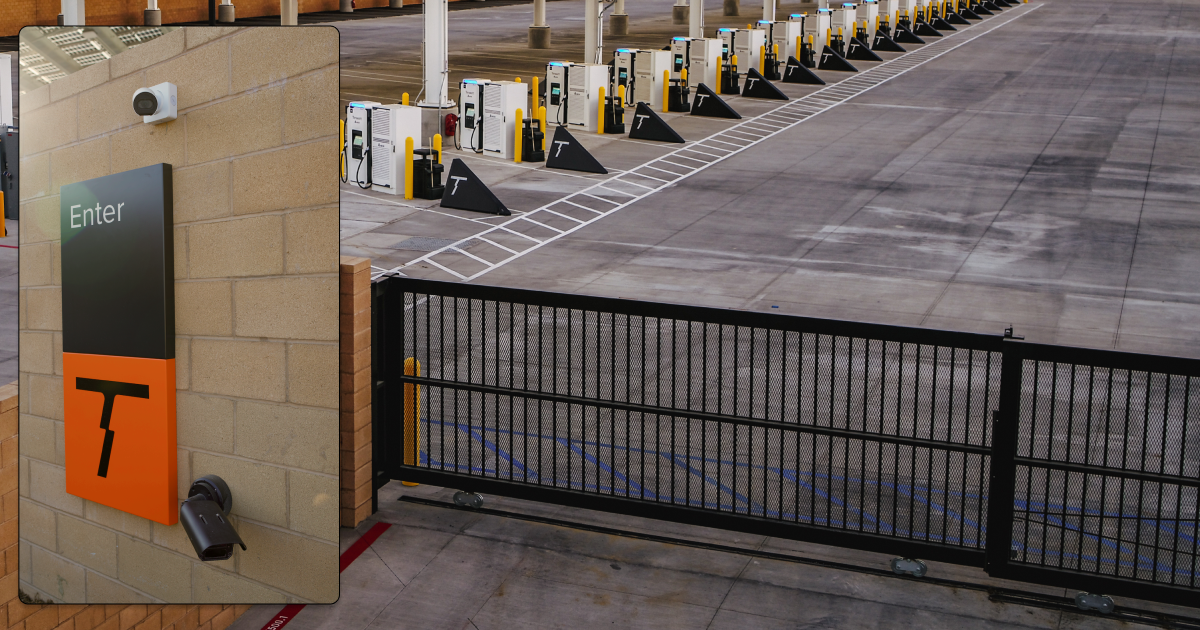
Site access: We have a fully automated site access control system, with a License Plate Reader and Gate Controller that determines if a vehicle has site access and charging rights before granting entry. Our site access system and displays guide customers with details about their reservation and routes them to the stall that's right for their vehicle needs.
Charging session: Our Charge Management System (CMS) offers a unified experience across all of our sites, ensuring customers can charge when they arrive and we can deliver the maximum power to their vehicle. Vehicles are automatically authenticated; once a session begins, operators can access live status reporting and notifications, so they can track exactly what’s happening on a per-vehicle basis.
Our Load Management system distributes available power dynamically among the many live sessions, rebalancing in real-time in response to changes in available utility power and active charge sessions (read more about how this works here). This level of dynamic control does three things at once: keeps us compliant with utility limits, lets us bring sites online faster without waiting years for grid upgrades, and optimizes costs for customers. It’s also a prerequisite for full scale electrification: without sophisticated site-level power management that optimizes consumption and cost, operators and utilities can’t get the most out of available grid capacity.
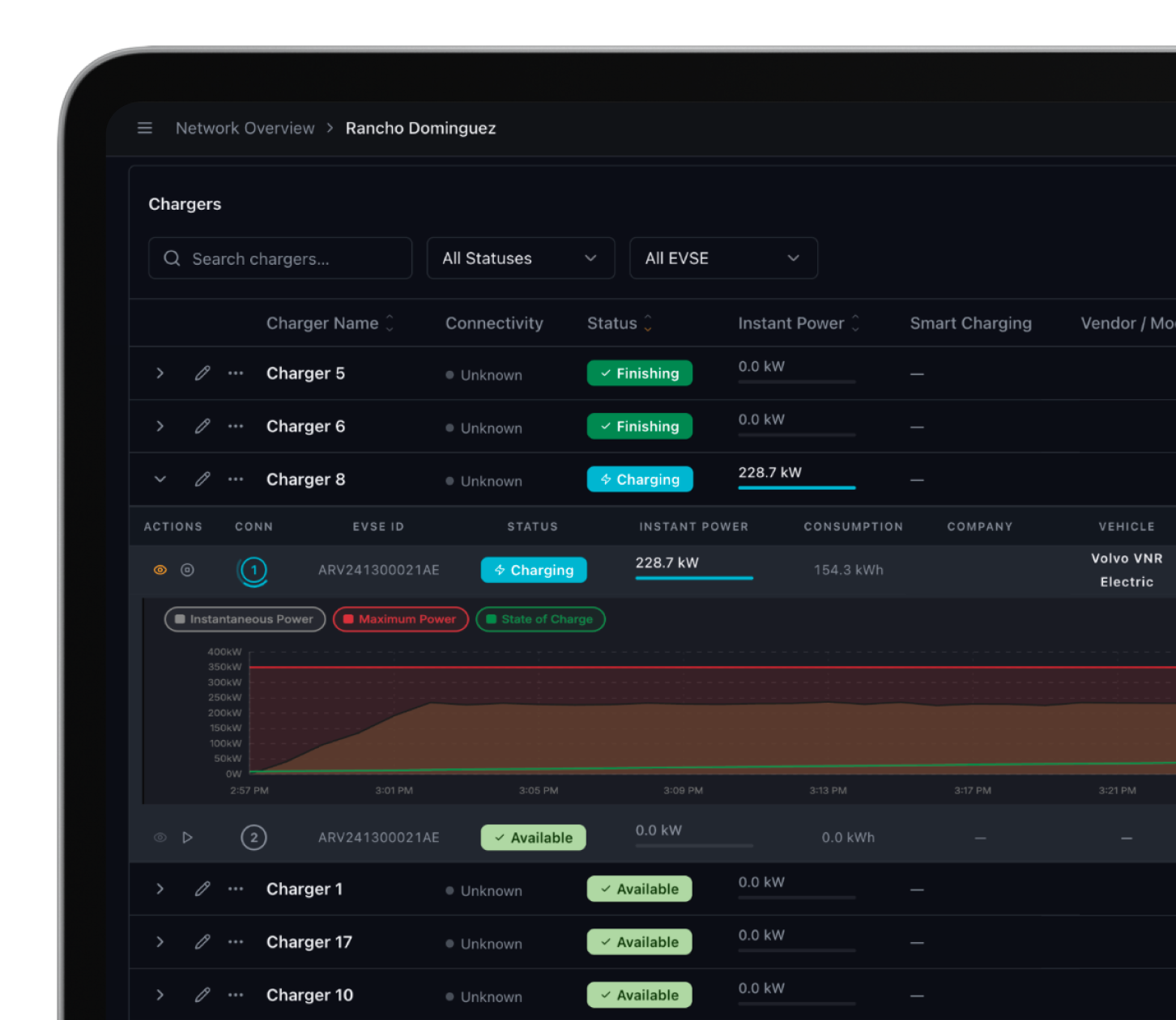
Billing and reporting: After each session, we provide charge session data to customers along with relevant per kWh billing so that they can access the data they need on their fleet without needing a separate reporting layer. Reporting is available through dashboards in our CMS in real time, which shows charge curves for in-progress and historical charge sessions, providing customers with insights on power delivery over the session duration.
Operational support: We maintain full 24/7 visibility into all of our sites. Our Ops team can proactively monitor, triage, and remotely resolve issues at any part of the customer journey – whether it’s at onboarding, site access, or during the charge session. Our 24x7 NOC team ensures that we identify and resolve the issues on our sites without customers ever noticing an impediment to their operations. This tight coupling of our technology and operations gives our customers a best in class partner that can deliver the reliability and performance that keeps their fleets in motion.
What this means for fleet operators
Across each of these pieces, our technology enables us to deliver best-in-class service: autonomous and dynamic on the backend, and reliable and easy to use on the frontend.
This translates into real-world benefits for our customers. Less time spent on:
- Managing charging operations
- Troubleshooting compatibility issues
- Queuing for available stalls
- Dealing with faulty chargers
- Waiting for expensive utility upgrades
- Tripping utility limits
And more revenue time on the road.
Add in our strategic site selection and portfolio and partnerships with utilities to maximize power, and you can see why Terawatt is the charging provider of choice for the biggest brands in EV and AV fleets today.
If you want to be part of a global team that’s working to electrify all miles, take a look at our open roles and come join us.