

Does the Tesla Semi Actually Save Money Over Diesel? Here's What the Data Shows
With the Tesla Semi now officially on American roads, we know fleets are weighing the purchase decision. We ran the numbers to gauge whether the Semi, as it exists today, can costs compared to its diesel equivalent.
The short answer: yes, by roughly $0.34 per mile in variable operating cost, based on current diesel prices and published Tesla Semi specifications.
But that advantage only holds if the truck charges well. Get charging wrong, and an electric truck can underperform the diesel it replaced.
Keep reading for all the details.
How does the Tesla Semi's upfront cost compare to diesel?
A new diesel Class 8 tractor has a median price of $172,500, based on 2025 model year data. The Tesla Semi is quoted at approximately $290,000 for the Long Range, 500-mile configuration. And with current California incentives factored in, that puts the Tesla Semi close to price parity with diesel, a first for a Class 8 electric truck.
How do range and charging time compare?
Gen 1 electric trucks are rated for 155 to 275 miles depending on model and battery pack and take 60 to 90 minutes to reach 60% charge. The Tesla Semi is rated for 500 miles and, using its 1.2 MW Megacharger, reaches 60% charge in about 30 minutes.
What does the Tesla Semi cost per mile to operate versus diesel?
Building out the full variable cost stack (energy, maintenance, tires, and driver labor) diesel runs $2.451 per mile. A Gen 1 electric truck comes in at $2.364 per mile. The Tesla Semi comes in lowest, at $2.114 per mile — that's savings of about $0.34 per mile against diesel.*
That gap comes almost entirely from energy cost, where the Semi's efficiency beats both diesel and Gen 1 electric trucks.
What does that mean for a fleet's bottom line?
On a typical drayage route, a 130-mile round trip at $600 per container, that $0.34/mile advantage works out to about $44 more contribution margin per move than a comparable diesel truck. Across three turns a day and 250 working days a year, that is roughly $33,000 in additional margin per truck, per year. A fleet could also hold pricing steady and underbid diesel competitors at around $556 per container while matching their margin.
Does the Tesla Semi's cost advantage hold up in daily operations?
It all depends on how you optimize your operations. Running the same 130-mile, three-turn route, an optimized day — where charging happens when and how it’s designed to — nets about $975 in contribution margin. An unoptimized day on the identical route and truck nets only $530, well under the $844 diesel benchmark for the same route.**
Get charging wrong, and the electric truck can fall behind the diesel truck it was meant to replace.
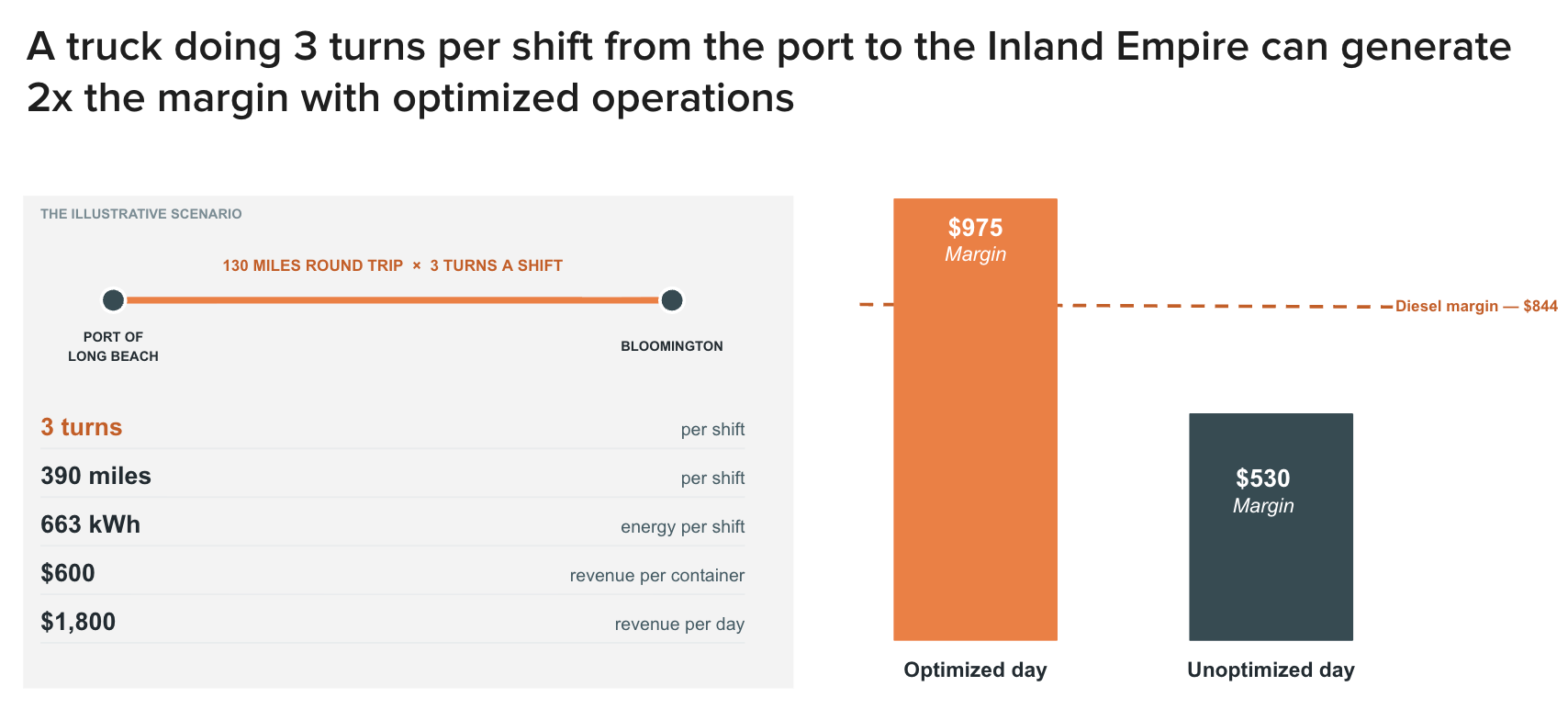
Three variables drive that swing.
How you charge. A 663 kWh refill, a full shift's energy, takes about 53 minutes at a sustained 750 kW. If the truck has to wait for an open stall or gets throttled to a lower power level, that session can stretch toward 100 minutes, often enough to cost the truck its third turn of the day. That is roughly $325 in lost margin.
Where you charge. A charger positioned on the actual route costs nothing extra. A charger off the lane, even a 10-mile detour, adds cost at the truck's full $2.114-per-mile rate with no revenue to offset it. That is about $21 in lost margin.
When you charge. Utility rates vary sharply by time of day. Charging during the 4 to 9 PM peak window, especially with a driver on the clock waiting for it to finish, can cost $100 or more per session compared with charging off-peak between shifts.
Together, the difference between a fleet that gets all three right and one that does not is more than $110,000 per truck, per year.
What does a fleet need to capture the Tesla Semi's full economic advantage?
Charging that is private and reservable, so there is no waiting or queuing. Charging positioned on or near the routes a fleet actually runs, so there is no unpaid detour. And charging priced and scheduled to avoid peak utility hours, so energy costs stay low.
That is the infrastructure Terawatt operates. Our sites across the LA Basin, live today in Rancho Dominguez, Rialto, and Commerce, with the I-10 corridor coming online next, are private and reserved for the fleets that use them, with pull-through access so trucks are not queuing or drop-and-hooking. Our software automatically shifts charging into off-peak windows, saving current Terawatt customers more than $100 per charge compared with charging on-peak.
The Tesla Semi makes the economic case for electrified drayage real. Capturing that advantage in daily operations comes down to charging infrastructure, and that is the problem Terawatt is built to solve.
*Figures cited are based on publicly available data as noted above and illustrative operating assumptions from Terawatt's internal analysis. Actual results will vary by route, rate, and fleet. Sources: diesel $7.04/gal — EIA California No. 2 diesel retail, week ending 24 Aug 2026 at 6 mpg. Maintenance $0.200/mi diesel, $0.176/mi BEV — ICCT Class 8 TCO, Apr 2023. Tires: ATRI Operational Costs of Trucking 2026 Update (2025 data) gives $0.050/mi fleet-wide; the electric trucks here carry a 20% penalty to $0.060/mi. The 20% is Michelin's published passenger-EV figure, applied as an assumption. Efficiency 2.2 kWh/mi Gen 1, 1.7 kWh/mi Tesla (Tesla configurator / CA HVIP spec). Charging modeled across a $0.30 – $0.70/kWh band. Driver labor $1.028/mi — ATRI 2026 Update driver wages ($0.818) plus benefits ($0.210), identical across all three.
**A Tesla Semi running drayage from the Port of Long Beach to a warehouse in Bloomington. Three turns per shift over a 10–14 hour shift per CALSTART, Key Performance Parameters for Drayage Trucks, I-710 Project, Nov 2013. Energy per shift is 390 miles at 1.7 kWh/mi (Tesla configurator / CA HVIP specification). Revenue is 3 turns x $600 = $1,800 a day, Operating cost is energy, maintenance, tires and driver labor