
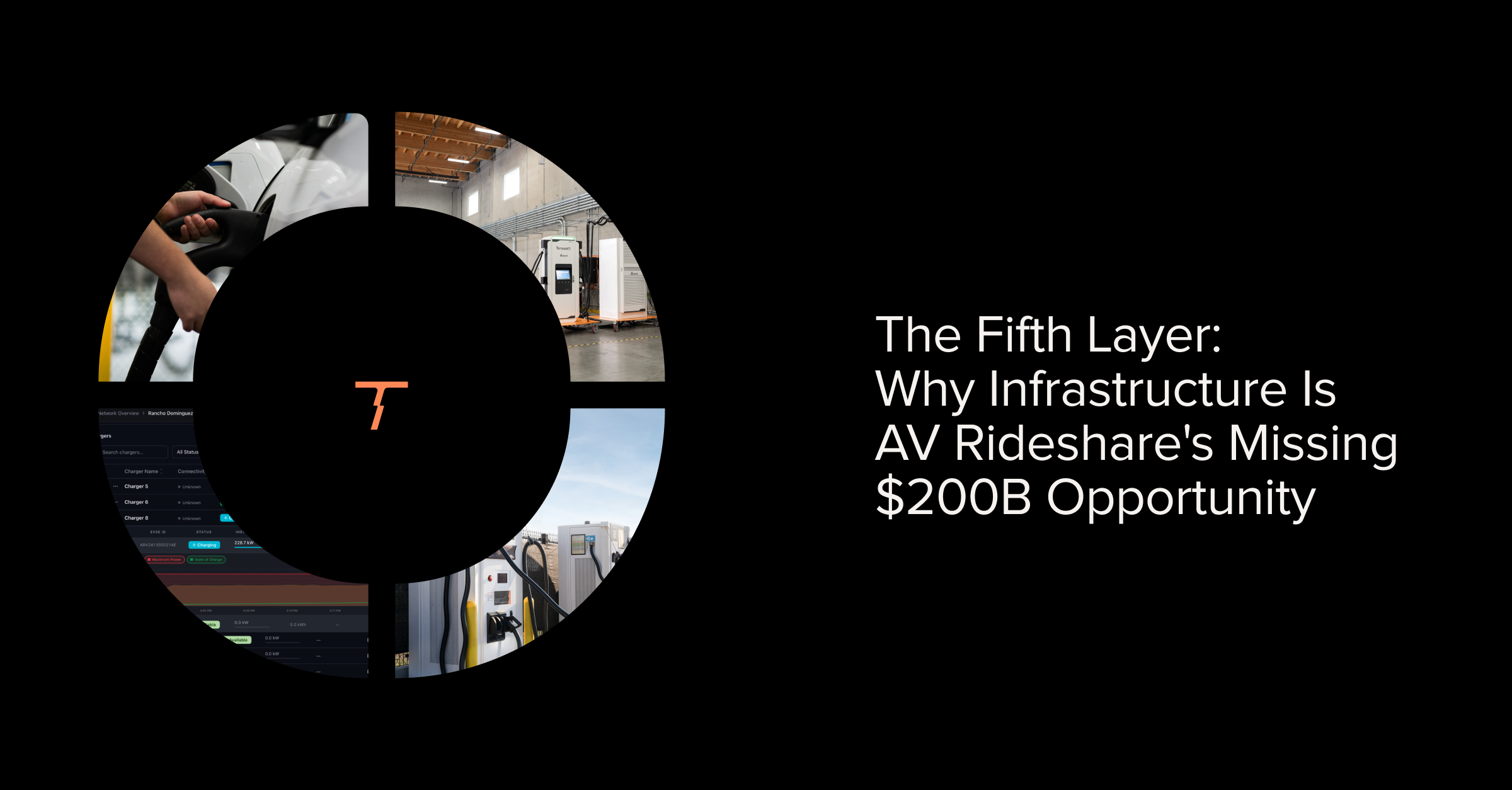
The Fifth Layer: Why Infrastructure Is AV Rideshare's Missing $200B Opportunity
As the AV rideshare market picks up speed, people are starting to focus on which layers of the ecosystem are the most competitive, and what layer will be the hardest to fulfill. But a $200B* piece of it keeps getting left out of the analysis.
What are the four layers of the AV rideshare stack?
The first layer is the AV tech stack itself — the sensors and compute that make self-driving possible. There's a race to own the AV operating system, with some players focused purely on tech and others vertically integrating into vehicles too. The stack will likely converge as it matures, and it draws the most investment and attention today.
The second layer is the apps that connect riders to vehicles. We tend to treat the platform as the most important part of any tech story, and app providers do have real-world data on how people use rideshare and where revenue flows across the ecosystem. It wasn't long ago that this layer was the cutting edge.
The third layer is the companies that own and finance fleets. This is largely invisible, but it's capital-intensive: AV tech can add tens of thousands of dollars to the cost of a vehicle. It remains a meaningful segment, even as the underlying tech gets cheaper and operators shift to more affordable vehicles.
The fourth layer is operations — data ops, maintenance, everything that keeps a fleet running. This is the backbone of autonomy, and AV-native providers have a head start here. That gap will close as more operators bring AVs into existing fleets and build out their own ops capabilities.
And then there’s the missing fifth piece: infrastructure.
Why isn't infrastructure counted as its own layer?
The vast majority of AVs are electric, so AV rideshare at scale depends on a network of charging sites — power and data connections in the right locations. Without power, an AV can't serve a single customer. Without a network, it can't serve a city. Building that network is a large business in its own right, the way gas stations were for the last generation of vehicles.
This often gets folded into the "operations" layer. It shouldn't be. Infrastructure requires specialized expertise, large amounts of capital most fleet operators don't have, and the ability to develop and run a network of sites at once — a combination that doesn't sit neatly inside any of the other four layers. As the ecosystem scales, specialist providers are best positioned to partner with fleets to build it. Think of the data centers that power AI: you can't have the technology without the infrastructure underneath it.
How much capital does AV charging infrastructure require?
First, the capital requirements are kind of insane. Building physical infrastructure takes significant upfront capital – a single site can cost tens of millions of dollars all-in – and most fleet operators simply don’t have the resources to devote to managing a real estate and hardware portfolio on top of their existing fleet costs.
At Terawatt, we will invest and commit well over a billion dollars by the end of 2027, for the existing regions that we serve. But that’s only the start: the number of AVs on the road is projected to grow 200x by 2035, which is where that $200B of infrastructure investment comes in. Because we are focused on building the infrastructure for electrification at scale we are able to secure the capital to finance this at lower cost which translates into better margins for operators. And we can do this at scale: not just one or two sites at a time, but dozens in parallel.
Why can't fleet operators build this themselves?
Because it requires bringing together expertise across real estate acquisition, land use and permitting, site development, power procurement, electrical and data connectivity, charge management, and site operations. That's a specialist team, and for most operators, a turnkey solution beats assembling that team in-house.
Experience building at scale matters just as much. Standing up a single site is already a multi-year lift. Running a fully integrated network of sites with a consistent customer experience and technology stack is a different problem entirely. AV rideshare is scaling now, and operators don't have the runway to build, learn, and iterate as they go. As in other infrastructure-heavy industries, the fastest path from zero to one runs through a specialized provider that can deliver parallel builds, on time, across multiple markets.
What will it take to keep pace with AV adoption?
Building infrastructure for AV fleets has its own economics and its own operating challenges — specialized expertise in site development and operations, and large amounts of capital to finance powered land at scale. This is the foundation layer of the AV revolution, and it will take a generational level of investment and execution to keep pace with adoption.
The race is on to build this missing piece of the stack. As more AV fleets scale into more geographies, the fifth layer won't stay hidden much longer.
*Based on Terawatt analysis of number of new charging depots required to meet BNEF expected number of AVs on the road by 2040, along with average CapEx per depot.